- Inceptly
- Posts
- $1M/month with a story that does all the work💰
$1M/month with a story that does all the work💰
Smooche Foundation Case Study
Hey everyone! The reason I want to break this one down isn't only to understand why it works. It's to show how the Inceptly Modular Creative System gives you a way to analyze ads like this and generate iterations from them. Once you can identify which part of an ad is doing which job, you have a production blueprint, not just a competitive teardown. |  Author: |
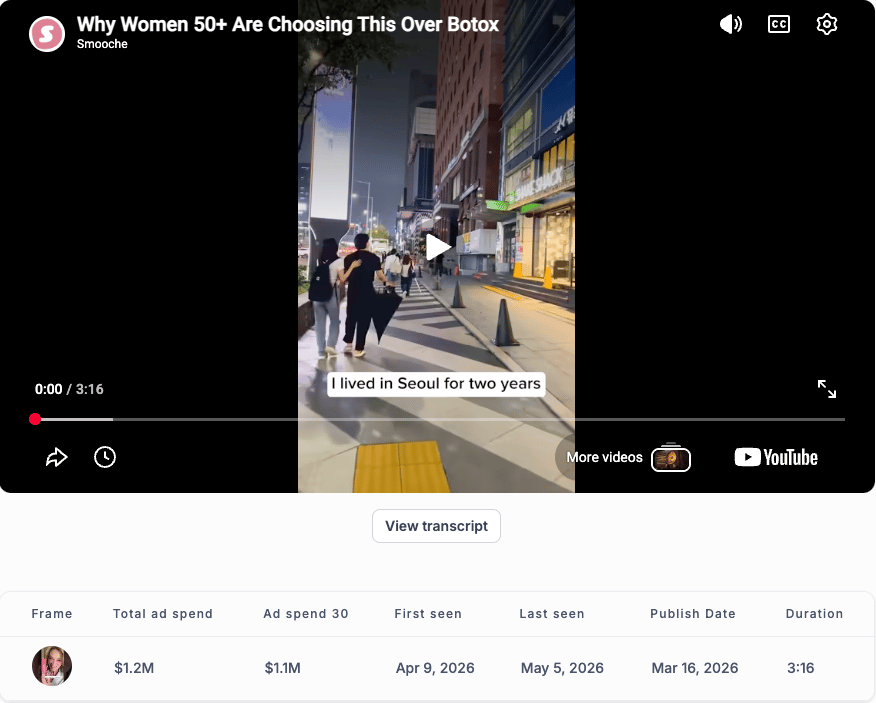
The ad runs for around three minutes. A woman talking to the camera about the two years she spent working in Seoul. By the time she mentions the product, the viewer has already been through the full argument, watched someone else's family ask if she got Botox, and understood exactly why their current moisturiser can't do what it promises. The sale is basically done before the CTA.
That structure is exactly what the taxonomy is built to map. If the framework is new to you, here's how it works.
Want to brainstorm with us on new ways to scale your business with YouTube Ads (and other performance video platforms)?
Join us for a free YouTube ad brainstorming session here:
The Inceptly Creative Taxonomy
We break almost every video ad into three parts: the Intro, the Bridge, and the Core. Each has a specific job.
The Intro's only job is to earn what comes next. It doesn't sell, it doesn't explain. It just makes stopping feel like a loss.
The Bridge does the belief work. This is where the ad wins or loses the argument before anyone's been asked to buy anything. A viewer goes in skeptical and, if the Bridge works, comes out genuinely open.
The Core converts attention into action. Two main types: Logic Lock (rational, evidence-based) and Identity Close (emotional, aspiration-driven).
When an ad works, or doesn't, you can point to the exact part that carried it or killed it. This one is clean enough to study.
The Intro: Curiosity (Open Loop)
“I lived in Seoul for 2 years for work. When I came back to the States, everyone asked if I got work done. I didn't. I just learned what Korean women actually use.”
Three sentences, and the ad already has the viewer. The Seoul detail does real work: she was there, this isn't something she read. The "did you get work done" moment delivers social proof before the product has been mentioned once, and the last line reframes what's coming as insider information rather than a pitch.
The entry mechanism is an Open Loop. "I just learned what Korean women actually use" deliberately withholds the answer. The viewer doesn't know what she learned. No pain is named, no frustration triggered. Just an incomplete piece of information the viewer wants resolved. That's what keeps them past nine seconds.
Worth noting what this Intro is not doing: it isn't explicitly activating a felt pain or naming a problem the viewer recognizes in themselves. The entry emotion is curiosity, not urgency. Which means the Bridge has to do the heavier belief work, and it does.
The Bridge: Reframe, mechanism, proof
This Bridge runs for roughly two and a half minutes. It earns all of it because it's doing three distinct jobs before the product gets a word in.
The Reframe comes first, through the Mi story. A 53-year-old colleague who looks 38 under the same fluorescent office lights, same stress, same hours. The ad lets the viewer hold the genetic assumption for a moment before pulling it apart.
“Mi's makeup routine was stupidly simple. One foundation in the morning. That's it. Meanwhile, I had a whole suitcase full of American products.”
That contrast is the Reframe doing its job. The viewer who's spent real money on skincare is now being told the problem wasn't effort or budget. Wrong product category entirely. And it lands through a story, so it doesn't feel like a claim.
The Mechanism arrives through dialogue, which is the smartest choice in the ad. The particle size and protein complex explanation is the kind of thing that reads as brand copy when a voiceover delivers it. Coming from a colleague over soju after work, it reads as something the viewer is finding out about rather than being sold.
“American women buy expensive foundations that sit on top of their skin and do nothing. Korean women buy foundations that actually go inside. That's the only difference.”
By the time Mi finishes explaining, the viewer understands at a technical level why their current products are failing. That's a harder belief to reverse than a vague feeling that something isn't working.
The Proof closes the Bridge in layers. The narrator's own results come first (two weeks, then two months), then Mi's reaction, then Chicago, which is the strongest beat in the ad.
“She grabbed my face and said: 'What did you do? Did you get Botox over there?'”
A sister asks. A best friend asks. An aunt pulls her aside at dinner. Each one independently, each one unprompted. By the time the third person reacts, it reads as a pattern rather than a testimonial. The viewer draws their own conclusions without feeling pushed toward one.
The Core: Logic lock
After a Bridge that long, the Core doesn't need to do much. Most of the conversion has already happened.
The product claims are brief and specific: 2 million tubes sold in Korea, pharmacist-recommended, Centella Asiatica, 251% faster absorption. Factual anchors, none dressed up as marketing.
The closer is what ties it together:
“If you've been doing everything right and your skin still looks tired, it's probably not your fault. Your products probably can't penetrate.”
Two jobs in two sentences. The first removes blame from the viewer (which your taxonomy calls Permission, and it's the only Permission beat in the entire ad). The second reactivates the Bridge Reframe one final time: the problem was always the category. The CTA after that is almost incidental. The viewer made the decision two minutes ago.
Worth noting: there's no discount, no urgency mechanic, no limited-time offer. A $1M/month ad running on belief alone. The Bridge is doing the conversion work that most brands hand off to a price incentive
What actually makes this work
The mechanism delivery is the most replicable thing in this ad. Framing a product explanation as something a friend said over drinks changes the trust register entirely. The viewer overhears the explanation rather than receiving it, and that's a meaningful gap. Someone who thinks they figured something out is a different buyer from someone who was just told it.
The proof sequencing matters too. Most ads stack testimonials at the end as a credibility layer. This ad builds proof into the narrative so each beat arrives as confirmation of something the viewer is already starting to believe. The aunt whispering at dinner lands as the third data point in a pattern, not as an endorsement.
And the length. Three minutes and twelve seconds is a choice. An ad spending $1M/month at that length means people are watching it. The viewer who reaches the end has been through a full belief shift. They're a fundamentally different buyer than someone who saw a 30-second cut.
The structure in brief: a Curiosity hook earns the story, the story delivers the Reframe and Mechanism through dialogue, proof arrives as a pattern of reactions rather than a list of testimonials, and a Logic Lock Core closes an audience that's already converted.
See you in the feed,
Alex and the Inceptly Team
Want to brainstorm with us on new ways to scale your business with YouTube Ads (and other performance video platforms)?
Join us for a free YouTube ad brainstorming session here:
| Alex Simic, Creative Director Alex Simic is the person responsible for all creative work that stands behind Inceptly since stepping into his role in 2022. He comes from the role of the Media Buying Team Lead and Strategist behind some of Inceptly’s biggest successes. He has collaborated with the biggest names in the Direct Response industry, whether as a Senior Account Manager & Media Buyer or Creative Director. His main goal is bridging the gap between Media Buying and Creative, ensuring that the videos Inceptly produces are data-based and giving our clients the best chance at achieving success. |
🎯 Inceptly’s top picks:
Essential reading you can't afford to skip

This Iota skincare ad proves a winning creative doesn’t need cinematic production, expensive visuals, or even a strong offer to get attention.
It got close to 2 million views because the script did the real work: it turned a familiar skincare problem into a belief-shifting argument.
In the full breakdown, we show how to take one proven ad idea and turn it into a matrix of new intros, stronger mechanisms, and fresh creative iterations.

This $1.6M pants ad proves that direct response doesn’t always need shock, hype, or a big dramatic hook.
It worked because every second had a job: gift framing, a named mechanism, quick visual proof, objection handling, risk reversal, and a clean CTA.
In the full breakdown, we unpack how a plastic package, a steam test, and a 45-day return turned a simple pair of pants into a disciplined 41-second sales machine.
Get in touch with us by responding to this email, or tagging us on LinkedIn or Instagram, and sharing your thoughts. Your feedback helps us keep our newsletter relevant and interesting.
