- Inceptly
- Posts
- $3.6M in 30 days on a “guy in a car” ad 🤨
$3.6M in 30 days on a “guy in a car” ad 🤨
There's a vertical video ad for hydroxyapatite toothpaste that has burned through an estimated $5.9 million in ad spend - $3.6 million of that in the last 30 days alone. When an ad scales that aggressively, it's not luck. It's by design. On the surface, this looks like a guy sitting in his car telling you something interesting he found online. Underneath, it's one of the tightest direct response ads running right now. And nearly every move it makes maps directly to principles Claude Hopkins laid out in Scientific Advertising - a book written over 100 years ago. |  Author: |

Want to brainstorm with us on new ways to scale your business with YouTube Ads (and other performance video platforms)?
Join us for a free YouTube ad brainstorming session here:
Let's break down exactly how.
It's a salesman in your feed
Hopkins' foundational rule: "Advertising is salesmanship multiplied." Every ad should work like a one-on-one sales conversation.
This ad does it literally. A guy in his car, talking directly to the camera, sharing something he discovered. No studio. No brand voice. No polish. It feels like a friend leaning over and saying, "Hey, you need to know about this." There's even a second person - a long-haired host reacting in the corner - who serves as a surrogate for the viewer, nodding along, pointing at evidence, modeling the exact response the ad wants you to have.
Hopkins said to avoid fine writing and clever styles if they distract from selling. This ad strips everything back to pure conversational persuasion.
Service first, product second
Hopkins insisted: people are selfish. Lead with what's in it for them. The best ads offer wanted information rather than asking people to buy.
This ad doesn't open with a product. It opens with a mystery: "Why is it that people outside of America can have teeth that are white naturally?" That question reframes the entire ad as a service - you're about to learn something valuable about your health that you didn't know. The product doesn't appear until the viewer already wants the solution. They feel like they're receiving insider knowledge, not being pitched.
Hopkins wrote that people can be coaxed, not driven. This ad coaxes beautifully.
The headline picks out its people in two seconds
Hopkins called the headline the most critical element: its job is to flag the right audience instantly, like calling out a name in a crowd.
In a scroll feed, you don't have a headline - you have the first two seconds. This ad nails it. "Check this out," plus an immediate close-up of glossy white teeth, plus the question about whiteness - anyone who has ever felt insecure about their smile stops scrolling. The red banner reading "I DID SOME DIGGING TO FIND THIS OUT…" layers on curiosity and self-selects people who want hidden information.
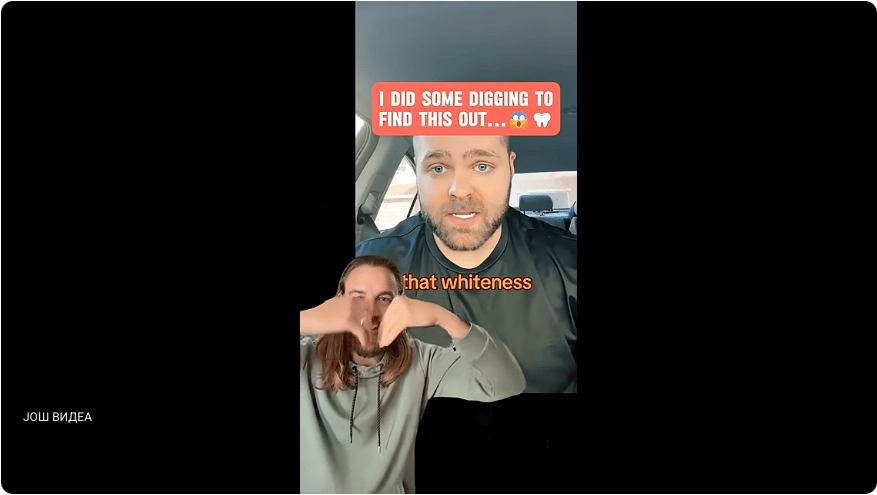
Hopkins said to spend significant time on headlines because a change can multiply returns five to ten times. The opening seconds of this ad are clearly engineered with that principle in mind.
Specifics that hit like facts
Hopkins was emphatic: generalities leave no impression. Specifics are believed.
This ad is stacked with them:
"Hydroxyapatite makes up 97% of tooth enamel."
Named countries: Japan, Canada
Named institutions: UT Health San Antonio, The Atlantic
"7.5%" printed on the tube itself
"2 weeks" as the results timeframe

Each claim is paired with on-screen evidence - article screenshots, study excerpts, highlighted text - the visual equivalent of Hopkins laying data on the table. He wrote that people accept specific facts at full value. This ad doesn't just state specifics. It shows the receipts.
The full story in less than 60 seconds
Hopkins' proven motto: "The more you tell, the more you sell."
In 58 seconds, this ad covers the problem (fluoride isn't optimal), the discovery (other countries use something different), the science (what hydroxyapatite does at the enamel level), the full benefit stack (sensitivity, cavities, whitening, remineralization), the mechanism (penetrates and fills microscopic cracks), social proof (a woman brushing, before-and-after photos), and a CTA with urgency (Black Friday, 50% off).
Nothing is left out. Every objection is preemptively handled. Hopkins said to consider each ad your one chance to convince a new customer and to present all your good arguments. This ad treats those 58 seconds exactly that way.
Every visual sells
Hopkins was ruthless about imagery: every picture must justify its space. It must sell, not decorate.
Every visual element in this ad works toward the sale. Teeth close-ups prime desire. Article screenshots serve as proof. A 3D tooth model makes the mechanism tangible. Product shots with blue gloves feel clinical and credible. The before-and-after comparison delivers the ultimate evidence. A thick yellow arrow in the final frame directs the eye toward the CTA. Not a single decorative frame exists. Every image advances the argument.

The curiosity engine
Hopkins identified curiosity as one of the strongest human incentives and noted that inviting comparison with rivals demonstrates confidence.
The entire ad is structured as a curiosity loop - "I found something they don't want you to know." The implicit rival is fluoride and the American dental establishment, framed not with hostility but with genuine puzzlement: "which makes no sense to me." This invites the viewer to question what they've always assumed. The "other countries already use this" angle creates a sense of being left behind, making the viewer feel like they're part of a select group discovering something ahead of the mainstream.
Why this ad scales
This ad proves Hopkins' thesis: advertising is not art - it's salesmanship governed by discoverable laws. The hook, the specifics, the stacked evidence, the complete story arc, the purposeful visuals, the urgent CTA - every element maps to principles written in 1923.
The format is new. The science of persuasion is not. And $5.9 million in ad spend tells you the only thing that matters: this ad converts.
P.S. Want to engineer ads that can actually hold spend at scale, like this $5.9M toothpaste creative? If you’re testing new hooks, stacking proof, or tightening your first 2 seconds, drop us a line. We’ll help you turn the patterns into a repeatable system you can run across offers and markets.
Let’s break down your funnel and see where scale is hiding!
Most brands wait too long to find out why YouTube isn’t working. We’ll show you what to test — and what to kill:
 | Jelena Denda Borjan, Staff Writer Drawing from her background in investigative journalism, Jelena has an exceptional ability to delve into any subject, no matter how complex, dig deep, and present information in a clear and accessible manner that empowers readers to grasp even the most intricate concepts with ease. |
🎯 Inceptly’s top picks:
Essential reading you can't afford to skip

3 totally different ads. Over $5M in spend. Same simple pattern.
They start with a problem you feel, blame one clear enemy, show one mechanism, then demo it so you stop doubting.
We broke down all 3 ads and the exact moves you can swipe for your next creatives.

Yesterday’s CPA looks bad, then magically “fixes itself” a few days later.
Not a tracking issue. Not Google being weird. It’s delayed attribution.
This post shows a simple way to see conversion maturity using only Google Sheets + Looker Studio, so you stop making decisions on unfinished data and start optimizing with calm, reliable numbers.
Get in touch with us by responding to this email or tagging us on LinkedIn or Instagram and sharing your thoughts. Your feedback helps us keep our newsletter relevant and interesting.
