- Inceptly
- Posts
- Are you agile enough to scale?🤔
Are you agile enough to scale?🤔
Scaling is rarely the thing that breaks accounts. What breaks accounts is scaling with the same pace, systems, and approvals you used when spend was small enough to “manage by feel.” When the budget climbs, the market does not slow down to match your internal process. The auction changes. Competitors adapt. |  Author: |
Agility in PPC is simple: short decision cycles, fast testing throughput, clear ownership, clean feedback loops between channels, creative, and the landing page.
If your default reaction to performance swings is “we need more data,” you’re already late.
Let’s talk about the four kinds of agility that decide whether you scale cleanly in 2026.
Want to brainstorm with us on new ways to scale your business with YouTube Ads (and other performance video platforms)?
Join us for a free YouTube ad brainstorming session here:
1) Creative agility: Volume
At low spend, you can survive with a handful of “good enough” assets.
At scale, creative jumps on a production line.

Because scaling increases exposure and frequency, that accelerates fatigue. What worked at $2000/day will pretty much die at $60,000/day. Not because the offer suddenly got worse, but because the audience gets saturated and the platform finds new pockets of users that respond to different angles.
Creative agility is your ability to produce, launch, and iterate at volume without turning it into chaos.
What this looks like at scale
A weekly creative pipeline that ships consistently, not “when we have time.”
Clear briefs tied to one hypothesis (angle, hook, format, proof)
Modular creative that’s easy to remix (new hook, same structure; new proof, same opening)
A review rhythm that is oriented on shipping, not debating
If your creative testing is sporadic, you’re not running a system. You’re gambling with a budget. And the bigger the budget, the more expensive the gambling habit gets.
2) Learning agility: Channels are one body now
They always have been, but still, many do not get this. Simply, forget the times when Facebook, Google, Native, and other platforms lived as separate planets, run by different teams with no interaction.
People do not experience your marketing in channels. They experience it as one continuous reality:
They see a Meta ad, then Google you later.
They watch a YouTube ad, then convert through a brand search.
They hit your site from Shopping, then get retargeted on Meta.
Let’s be honest, most conversions do not happen because someone saw one ad and had a spiritual awakening.
They happen after a pile of touchpoints.
We see this daily at Inceptly. The customer gets hit from multiple angles before they finally convert. That path is messy, cross-channel, and very real.
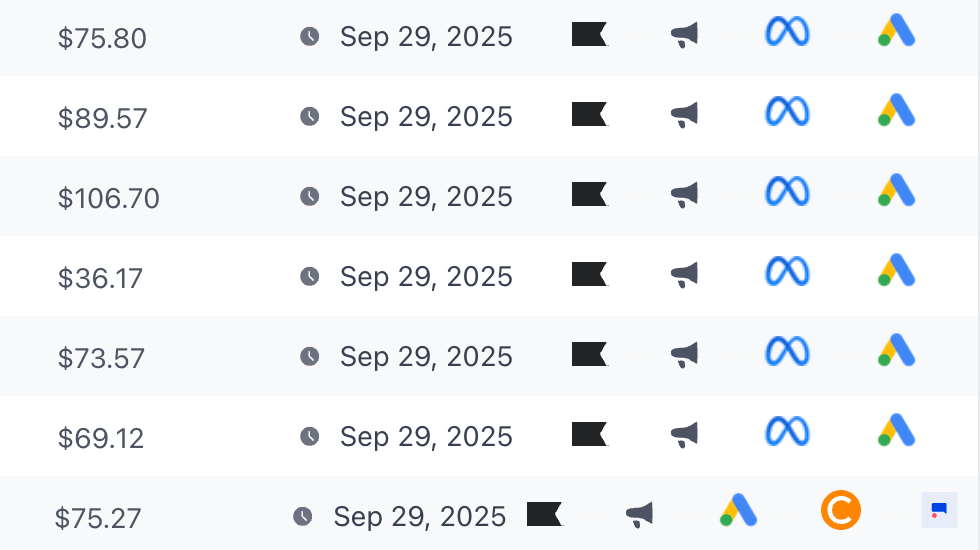
This is a swimming marathon, so to say.
Meta is your legs. Google is your hands.
You do not finish with weak legs and strong hands. You do not finish with strong legs and weak hands either.
The point is simple. The body has to work as one unit.
The market does not care about your org chart.
Your customer does not wake up and say, “Today I’m in a Meta mood.” Then switch to “Google mode” after lunch.
They bounce through touchpoints like a pinball, and they decide when they decide.
So if your legs are kicking in one direction and your hands are pulling in another, you are not “multi-channel.” You’re uncoordinated.
You look busy. You feel busy. You just do not move forward.
Behind that body is one control center: the brain.
In PPC terms, that brain is your system. One learning loop that connects it all. That’s how you finish the marathon while everyone else is still arguing about which muscle deserves the credit.
So if your learnings are trapped in channel silos, you are losing speed, you are behind.
Learning agility is your ability to take what is working in one network and deploy it in another before the market catches up.
At Inceptly, we treat networks as one system. Weekly, we force the exact flow, here is a small part:
A creative winner in PMax gets tested in Demand Gen.
A native-style image that pops on Google surfaces gets tested in Meta.
A Meta hook that drives strong click intent becomes a Search and YouTube angle test.
And many, many more we do within our system…
Sometimes the “weird” creative wins. Native-looking assets can outperform polished “classic platform” statics. If you are not cross-testing, you would never learn that.
What we learned is, you never know until you really try. That is called testing.
3) Funnel agility: test like it’s your job, because it is
Funnels are never “done.” They’re either improving or decaying. Funnel is live, only if it is agile. No discussion.
Funnel agility means constant, systemized testing with clean comparisons. Not random landing page changes, mixed with creative changes, mixed with offer changes.
One of the most reliable success patterns we’ve seen is using PMax as a funnel testing engine.
The clean way to do it
Run structured tests inside asset groups
Duplicate the asset group
Change one thing only: the final URL
Keep everything else identical
Disable URL expansion; otherwise, your test is not a test
This matters because PMax will happily “help” you by sending traffic to different URLs. Great for volume, terrible for measurement. If URL expansion is on, you do not know what you’re actually testing.
Funnel agility is not about having ideas. Everyone has ideas.
It’s about doing controlled tests, quickly, repeatedly, and learning fast enough to compound the wins.
4) Feed agility: Forget old-school feed optimization
In 2026, feed agility is not “swap a few keywords in the title and hope.”
Feed agility is your response to AI-shaped search experiences.
The feed is no longer a static catalog. It’s an input into how machines understand your product, match it to demand, and decide when to show you.
The biggest lever here is demand understanding.
The practical approach
Study your best search terms until you actually understand demand
Not what you sell. What they want.Separate branded vs cold intent
Cold intent tells you how the market describes the problem and the desired outcome.Build product variant tests based on that demand
Work with your team to prepare different:
Titles
Descriptions
Images
Then run them as structured feed variant tests over time. Let them breathe long enough to gather a real signal, and watch what happens to:
Best-performing search queries
Cold query volume and efficiency
Branded query behavior
Feed agility is a long-term advantage. Most teams treat feeds like admin work. In 2026, that mindset is a no-go.
In 2026… Be ready. Be proactive, not reactive.
Being reactive means you’re late.
Assuming you have any competition, that’s not an option.
Cheers.

Want to brainstorm with us on new ways to scale your business with YouTube Ads (and other performance video platforms)?
Join us for a free YouTube ad brainstorming session here:
 | Vesna Vukanovic Dumanovic, Account Manager Armed with a PhD in Knowledge Management, as well as insatiable curiosity and a can-do attitude, Vesna is an organizational powerhouse on our team. As a veteran in project management, there's no question or task you can throw at her that she wouldn't be able to tackle. That's why she's the go-to resource for education, development, and support not just for our team but for Inceptly's clients. |
🎯 Inceptly’s top picks:
Essential reading you can't afford to skip

Non-English YouTube ads are quietly outspending most English ones… and you’d never notice unless you went looking.
We found a Spanish ad that cleared $500K in under a month with a setup that looks almost too simple: front camera, light edits, straight talk. The twist is the opening line. He admits you’ve seen him before, then turns that “ugh, again?” feeling into a credibility proof chain that actually makes sense.
If you’re fighting ad fatigue right now, this breakdown will give you a clean pattern you can steal today: self-aware hook → logic as proof → real-world pain → clear next step.
Most of what “worked” in 2025 was luck, then we called it a plan.
This post breaks down 5 hard lessons from accounts that actually scale:
Your “best audience” is usually an accident, signals matter more
Tight tCPA or tROAS can kill volume because you show up less
PMax needs daily checks, or it burnsthe budget fast
Auction Insights tells you who’s beating you and where
Real growth comes from one learning system across the whole account
If your results feel jumpy lately, this will make the next steps obvious.
Get in touch with us by responding to this email or tagging us on LinkedIn or Instagram, and sharing your thoughts. Your feedback helps us keep our newsletter relevant and interesting.
- This newsletter is brought to you by -

Are you spending over $1K/day on ads and looking to scale your business with YouTube ads?