- Inceptly
- Posts
- 💰📈 How a 3-minute-long lead gen racked up $16.2M in ad spend
💰📈 How a 3-minute-long lead gen racked up $16.2M in ad spend
...and it’s still pulling $733K every 30 days! Here's the complete breakdown.
There's a quiet category of YouTube ads that most marketers overlook entirely. Here’s an ad exactly like that: |  Author: |
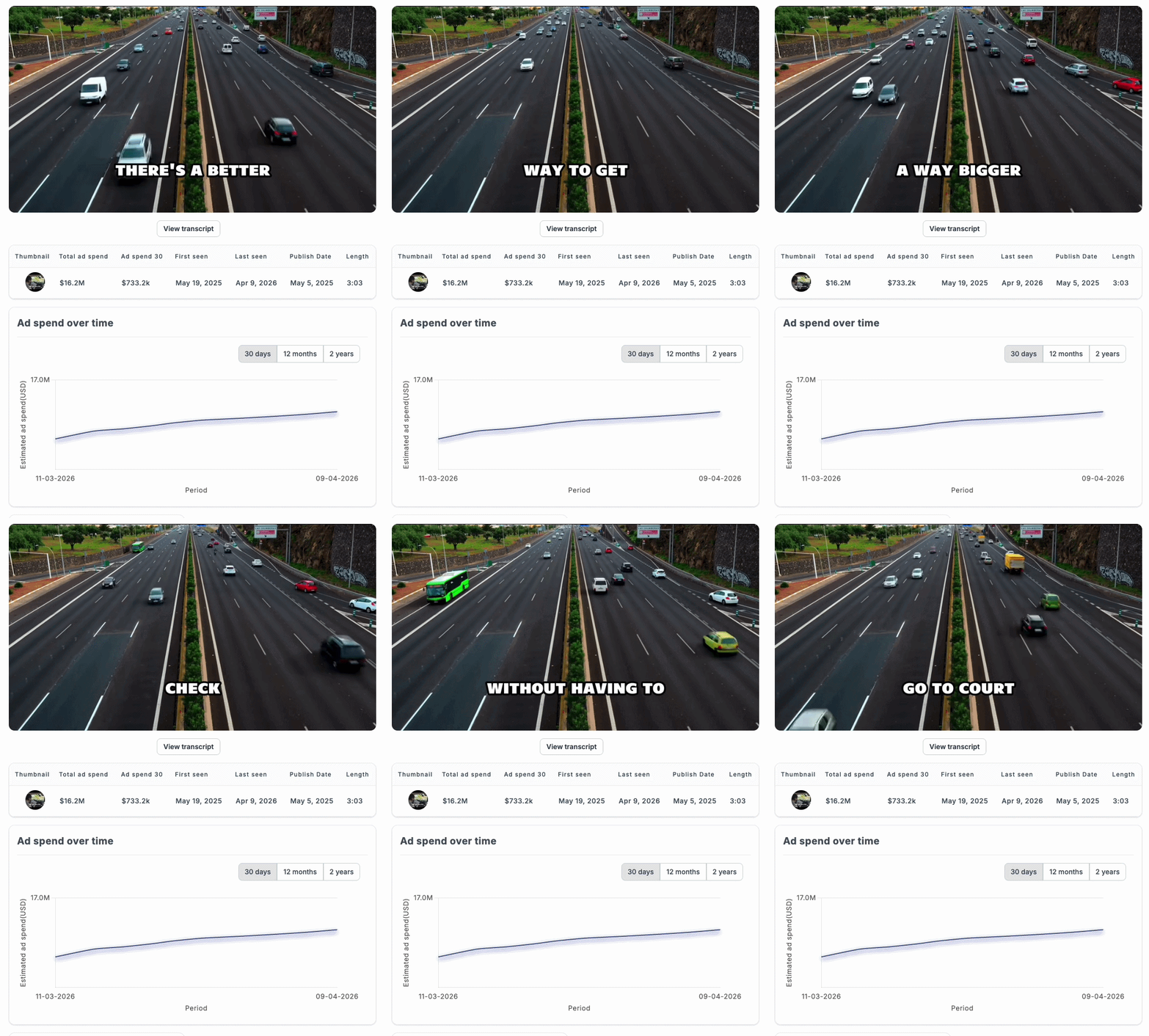
This ad includes just a voiceover, stock footage, and bold text subtitles - and somehow, it's one of the highest-spending ads in the legal services space right now!
This Crash Connect "2025 Compensation Program" ad has been live since May 2025.
It's spent an estimated $16.2 million in total, with $733k going out the door in just the last 30 days:
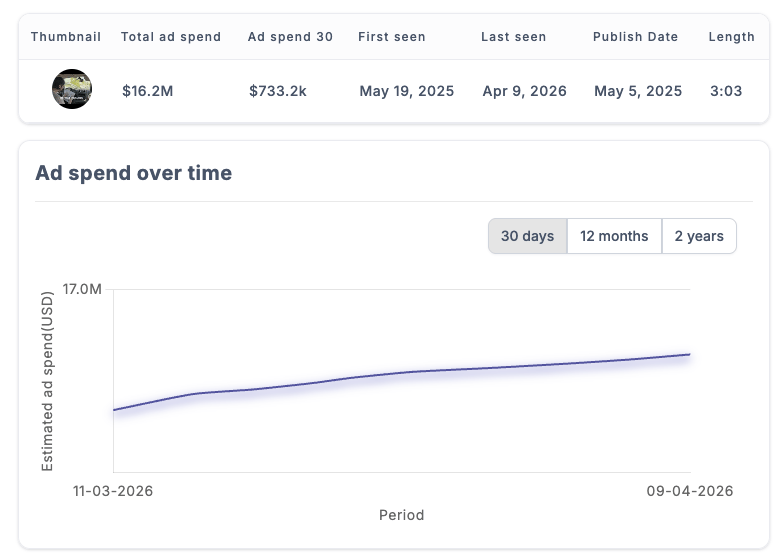
The spend curve is still climbing. And when you break down the script line by line, none of that is a surprise.
This isn't luck - this is architecture!
Want to brainstorm with us on new ways to scale your business with YouTube Ads (and other performance video platforms)?
Join us for a free YouTube ad brainstorming session here:
The hook that breaks the category
The first five words of this ad are doing something almost no personal injury ad ever does.
"Never sue the other driver."

Every lawyer ad on television, YouTube, and billboards tells you to call them and sue. That's the category script. Crash Connect opens by explicitly rejecting it - which immediately signals to the viewer that what follows is different, smarter, and more valuable than anything they've heard before.
This is called category disruption at the hook level, and it's one of the most powerful tools in direct response. When your opening line contradicts the expected script of your entire industry, you earn attention that competitors can't buy.
The rest of the hook stacks three promises in rapid sequence: a bigger check, no courtroom, no upfront fees. Every major objection a car accident victim has about pursuing compensation - it's too much work, I can't afford a lawyer, it'll take forever - is dismissed before the viewer has even processed the product name.
That's a complete pre-sell in under 10 seconds.
The "program" reframe
Here's a detail that most marketers would walk right past.
This ad is selling a lead gen form. Four multiple-choice questions that route accident victims to personal injury attorneys. That's the entire mechanism. But you'd never know it from watching.
Instead, it's called the "2025 Compensation Program."

That single naming decision transforms the entire experience. A form feels like work. A program feels like access. A form feels like something a company wants from you. A program feels like something being offered to a select few.
Adding "2025" signals currency - it implies recent legal changes, new regulations, updated guidelines that the viewer may have missed. It creates the sense that something has shifted in their favor and they just don't know about it yet.
Naming your funnel is one of the most underused tactics in lead gen marketing. The name Crash Connect chose turns a 30-second qualification quiz into a selective program that victims apply to join.
The proof story: Why $4,000 was the right number
The ad's testimonial "Josh" follows a structure worth studying carefully.

Insurance offered him $4,000. After the program, he received over $100,000.
The $4,000 anchor is not accidental. It's the exact amount a real insurance adjuster would offer as a first settlement on a moderate accident claim - low enough to feel like an insult, high enough to feel like a real number. It's universally recognizable to anyone who has dealt with insurance after an accident. It says: we know exactly what you were offered, and we know they lowballed you.
The $100,000 result is a 25x return. It's extraordinary but not impossible - which is the precise zone where testimonials do maximum persuasive work. Too small and it doesn't motivate. Too large and it triggers skepticism. $100K for a car accident claim lands in the "I could believe that" range for most viewers.
The detail that Josh's accident was already 5 months old when he came to them is also intentional, it expands the eligible audience to include people who've already settled or given up, making them feel re-qualified rather than disqualified.
The contingency fee close: The last objection killer
Legal advertising has one objection that kills more conversions than any other: I can't afford a lawyer.
The contingency fee model - you don't pay unless you win - is the structural answer to that objection. But most legal ads bury it. Crash Connect makes it a centerpiece, repeating it twice in the closing sequence.
"You don't pay a cent unless you win."

This is zero-risk framing at its most complete. The viewer has nothing to lose by clicking, nothing to lose by answering four questions, nothing to lose by talking to a specialist. Every financial barrier is removed simultaneously. The only cost of inaction is the compensation they're currently leaving on the table.
When your product or service has a contingency model, a free trial, a money-back guarantee, or any equivalent zero-risk structure - lead with it prominently. Crash Connect does this correctly.
The guilt shift: Making inaction feel like surrender
Around the two-minute mark, the ad makes its most psychologically sophisticated move.
"Insurance companies hope you never check what you're truly owed."

This single line reframes the entire viewer relationship with inaction. Before this moment, not clicking is a neutral choice - you just didn't act on an ad. After this moment, not clicking means you're letting the insurance company win. You're doing exactly what they hoped you'd do.
This is called the guilt shift - transferring responsibility for the viewer's inaction onto a villain who benefits from it. It's closely related to the outrage mechanism used in the Florida insurance ad analyzed earlier in this series, but deployed more elegantly here. There's no manufactured conspiracy, no fake whistleblower — just a clean, credible framing of corporate incentives that every accident victim will immediately recognize as true.
Insurance companies do lowball settlements. They do count on victims not knowing their rights. The guilt shift works here because it's not a lie — it's a reframe of something real.
The urgency mechanism: Using real scarcity
Most ads in this series manufacture urgency. Countdown timers. "Only 47 left." Gold quotas. Limited availability.
Crash Connect uses something far more powerful: the statute of limitations.
"These cases don't stay open forever. If you wait too long, you could lose your chance to claim what's yours."
This is a genuine, verifiable, legally grounded urgency. Personal injury claims do have filing deadlines. That deadline varies by state, but it's real - and the viewer knows it's real.
When scarcity is authentic, it converts harder than any manufactured countdown because the viewer can't rationalize it away.
The lesson for direct response marketers: always prefer real urgency over invented urgency. If your product has a genuine reason to act now - limited inventory, a real deadline, a price increase, a regulatory change - that will always outperform a fake timer.
Important takeways
1. Open against your category. "Never sue" in a personal injury ad earns more attention in five words than most ads earn in five seconds. Find the industry script everyone expects, then contradict it immediately.
2. Name your funnel. "The 2025 Compensation Program" converts better than "fill out this form" because it implies access, selectivity, and legitimacy. Whatever your lead gen mechanism is, give it a name that sounds like something worth joining.
3. Anchor your proof story in a recognizable lowball number. The $4,000 insurance offer is as important as the $100,000 result. The anchor makes the transformation believable because the starting point is universally familiar.
4. Lead with your zero-risk model. If your offer has a contingency fee, free trial, or money-back guarantee, don't bury it in the terms. Make it a headline feature of your pitch. Crash Connect mentions it twice.
5. Use real scarcity. The statute of limitations is the most credible urgency mechanism in this series because it's true. Real deadlines convert harder than manufactured ones.
6. The guilt shift turns inaction into surrender. "They're counting on you not to check" makes clicking feel like defiance and not clicking feel like compliance. When your audience has a genuine adversary - an insurance company, a landlord, a pharmaceutical giant - frame inaction as the villain winning.
The part where I tell you to ‘swipe’ this
Look, you're probably not running personal injury ads. But that's not the point.
The point is that this advertiser built a script in a Google Doc, used some stock footage, and has been printing $733K a month with it for almost a year. No influencer. No studio. No product demo. Just a really well-engineered argument for why a very specific person should click a link right now.
Every niche has its own version of the "never sue" hook - the counterintuitive opening that breaks the category script. Every funnel can be renamed into a program.
Every proof story has a wrong anchor number waiting to be replaced with the right one.
Every offer has a zero-risk angle that's being undersold somewhere in the fine print.
Put this info to some good use!
Want to brainstorm with us on new ways to scale your business with YouTube Ads (and other performance video platforms)?
Join us for a free YouTube ad brainstorming session here:
| Kristina Jovanovic, Social Media Manager & Content Writer Fascinated by human behavior, Kristina graduated with a degree in Psychology and joined our agency to put her knowledge to good use as a Media Buyer. She later transitioned into her current role, where she draws on her knowledge of the human psyche and marketing strategy, as well as hands-on experience in creative development and media buying at Inceptly, to share useful insights with our readers. |
🎯 Inceptly’s top picks:
Essential reading you can't afford to skip

A mom of seven. Missing teeth. Zero ad polish.
Most people would call it unscalable creative.
They’d be wrong. This ad spent $3.2M for a reason.

That “bad” campaign you paused might have been doing the job that kept your whole account working.
It looked inefficient on paper. It may have been holding everything together.
Get in touch with us by responding to this email, tagging us on LinkedIn or Instagram, and sharing your thoughts. Your feedback helps us keep our newsletter relevant and interesting.
