- Inceptly
- Posts
- I really hope 2025 taught you this...💡
I really hope 2025 taught you this...💡
1. Your best audience was an accidentTwo years ago, when an offer wasn’t converting, most brands did what humans always do under pressure: look for something to blame. And the easiest suspect was targeting. A media buyer could walk into a weekly call and say, “CPA is high on avid investors, let’s try another audience,” then pick something that sounded logical, run basically the same ads, and hope the new audience would do the heavy lifting. Sometimes it even “worked,” which made it worse, because it trained everyone to believe the audience picker was the hero. |  Author: |
Then you’d get the classic story: the SaaS offer finally scaled… and the best performing audience was “fast food lovers.” Not because burgers love software. Because the machine found a pocket of converters, and we slapped a neat story on it after the fact.
That era taught a brutal lesson: if targeting is the only lever you’re pulling, you’re mostly gambling. You’re not building a repeatable growth system, you’re spinning the wheel until you hit a hole, then calling it strategy. The big shift today is that the “audience” isn’t the steering wheel anymore. Signals are.
For a long time “targeting” meant picking the right box. Interests, lookalikes, tiny segments, and the feeling that you were in control. The platforms have been walking us away from that for years. Remember when we were introduced to “Optimized Targeting”? Google was telling us, politely, that the old game of fencing the machine into tiny boxes was going to stop. Tight segments feel controlled… You keep showing to the same people, the same auctions, the same patterns. Results look great until they don’t, then you get that familiar cycle: volume stalls, costs jump, and everyone starts blaming the offer or the landing page. The truth is simpler. You ran out of room.
Want to brainstorm with us on new ways to scale your business with YouTube Ads (and other performance video platforms)?
Join us for a free YouTube ad brainstorming session here:
2. Your tROAS or tCPA was never the goal. Winning more auctions is.
Targets are fine. We use them all the time. We just don’t love what happens when a target becomes the only thing the account is allowed to care about.
Because when you tighten tROAS or tCPA too much, Google bids down to protect the number. In the market, you’re simply showing up less. You’re not really “saving money.” You’re buying less opportunity.
Use them, but don’t choke the campaign when there is still room to capture more demand. If you have impression share you can win, top-of-page you can improve, or important queries you are missing, a tight target is often the reason. Loosen it enough to let the system bid into better positions, then watch what happens to total volume and the blended number across the account. Big accounts win by protecting the business goal while staying aggressive, where the auction is still giving you conversions.
3. PMax is not autopilot
Let me tell you what Performance Max really is at scale.
So when someone tells me, “PMax is a no-brainer”...

Because yes, it’s a no-brainer in the same way a sports car is easy to drive. You press the pedal, and it moves. The question is whether you’re holding the wheel when it hits 200. The first time you give PMax serious budget, it does what every smart system does when nobody is watching: it finds the easiest path to a win, and it takes it. Not the best path for your business. The easiest path. That is why people fall in love with it and get burned by it in the same quarter. It can look like a genius on Monday and like a toddler with your credit card on Thursday.
Look at the screenshot. This is a normal 90-day window on a scaled account: $975,731 in spend, and the performance line looks like an EKG. That’s not a “bad week.” That’s the platform constantly re-deciding where it wants to spend, which mix it wants to chase, and what it believes will hit the goal. Now imagine you only check this once a week. At this pace, one weak asset group can burn five figures before your next status call.
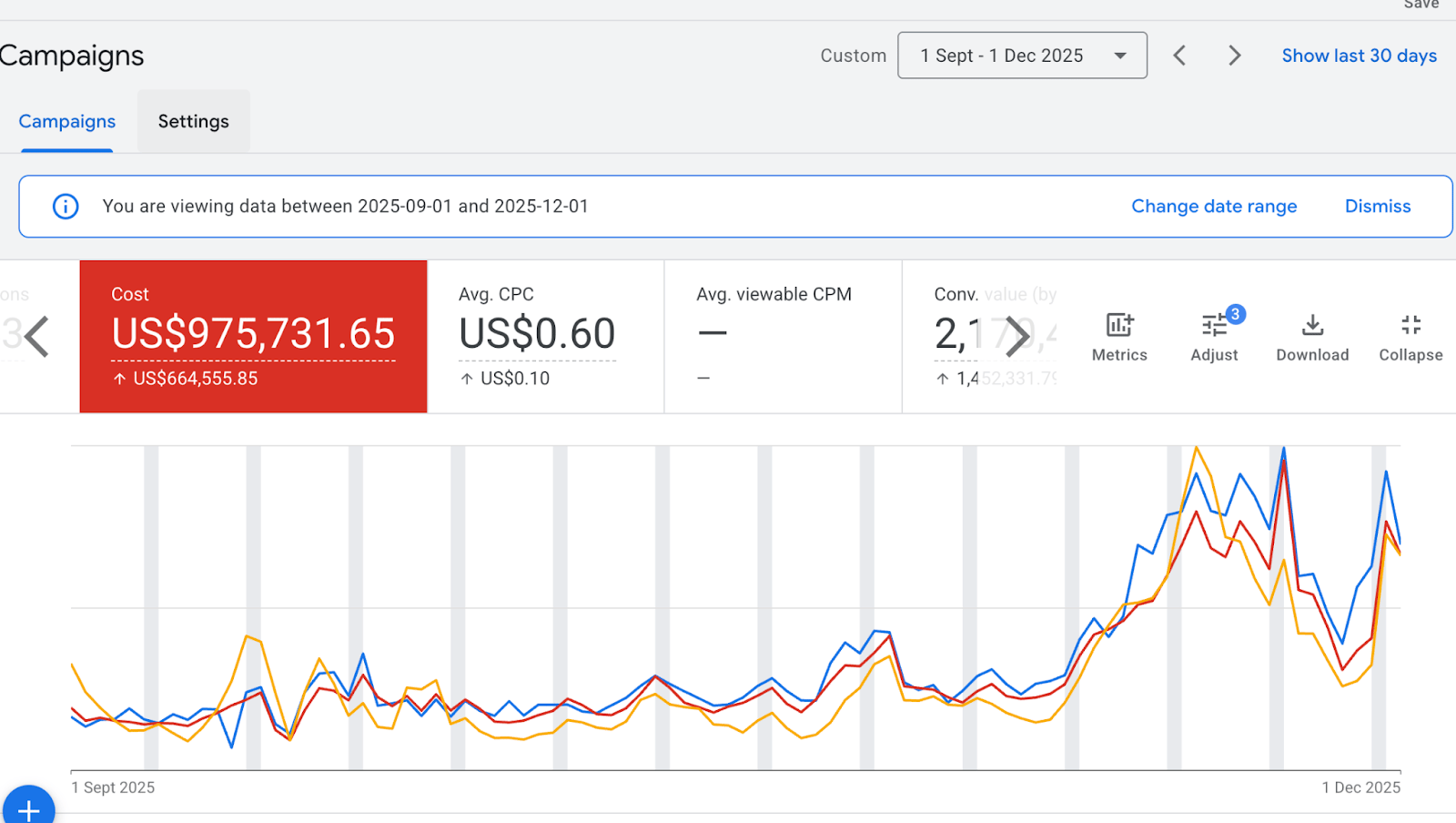
PMax needs daily oversight! Not because you’re a control freak (are you?). Because the system will shift what it spends on as soon as it senses a cheaper conversion somewhere else. Daily PMax management is simple. You look for the asset groups that are taking budget and not returning value. Not “eventually.” Not “in theory.” In reality. When you find one, you don’t negotiate with it. You replace the inputs fast. You swap, you fix.
4. Don’t tell me you didn’t check auction insights?!
Most accounts bleed money because nobody is watching the auction.
Not “performance.” The auction.
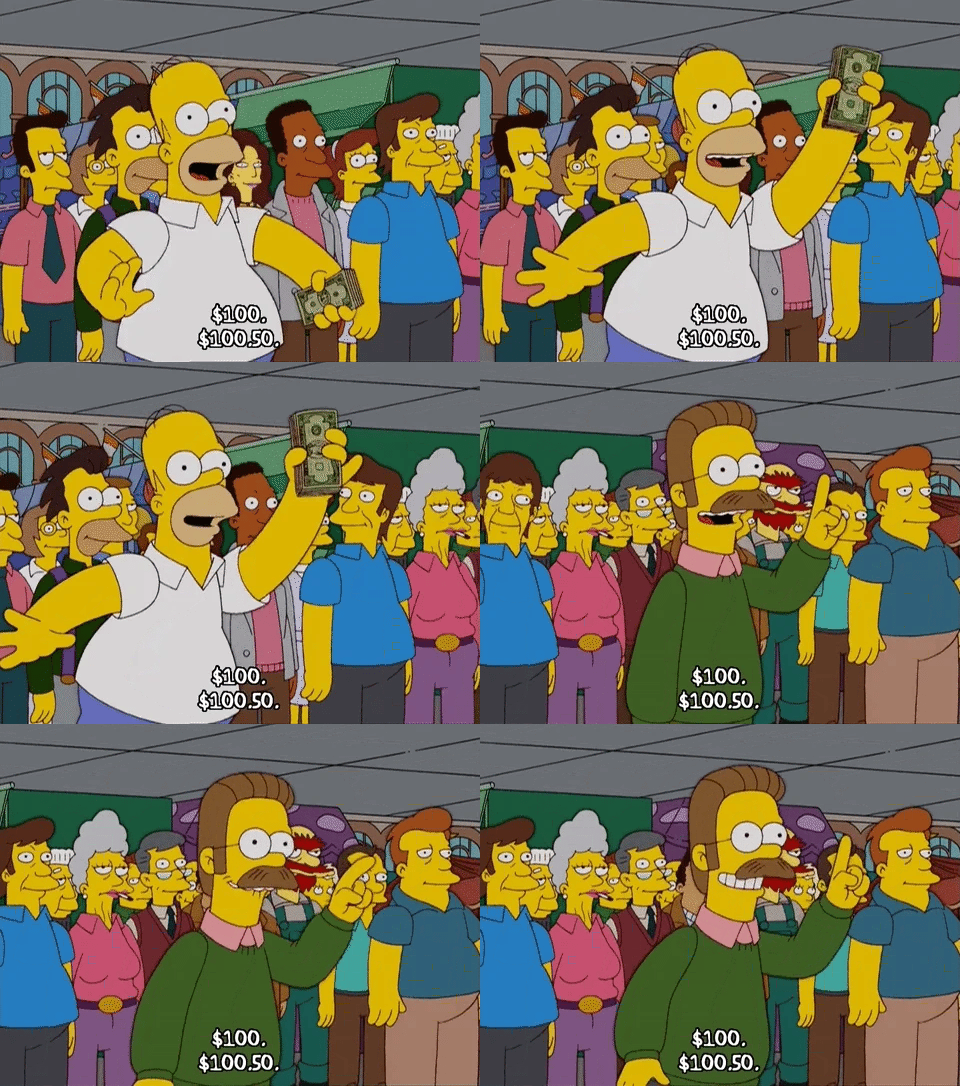
Because Google Ads is not you versus your KPI. It’s you versus whoever is showing up above you on the exact searches you want to own. Check this as a simple example:
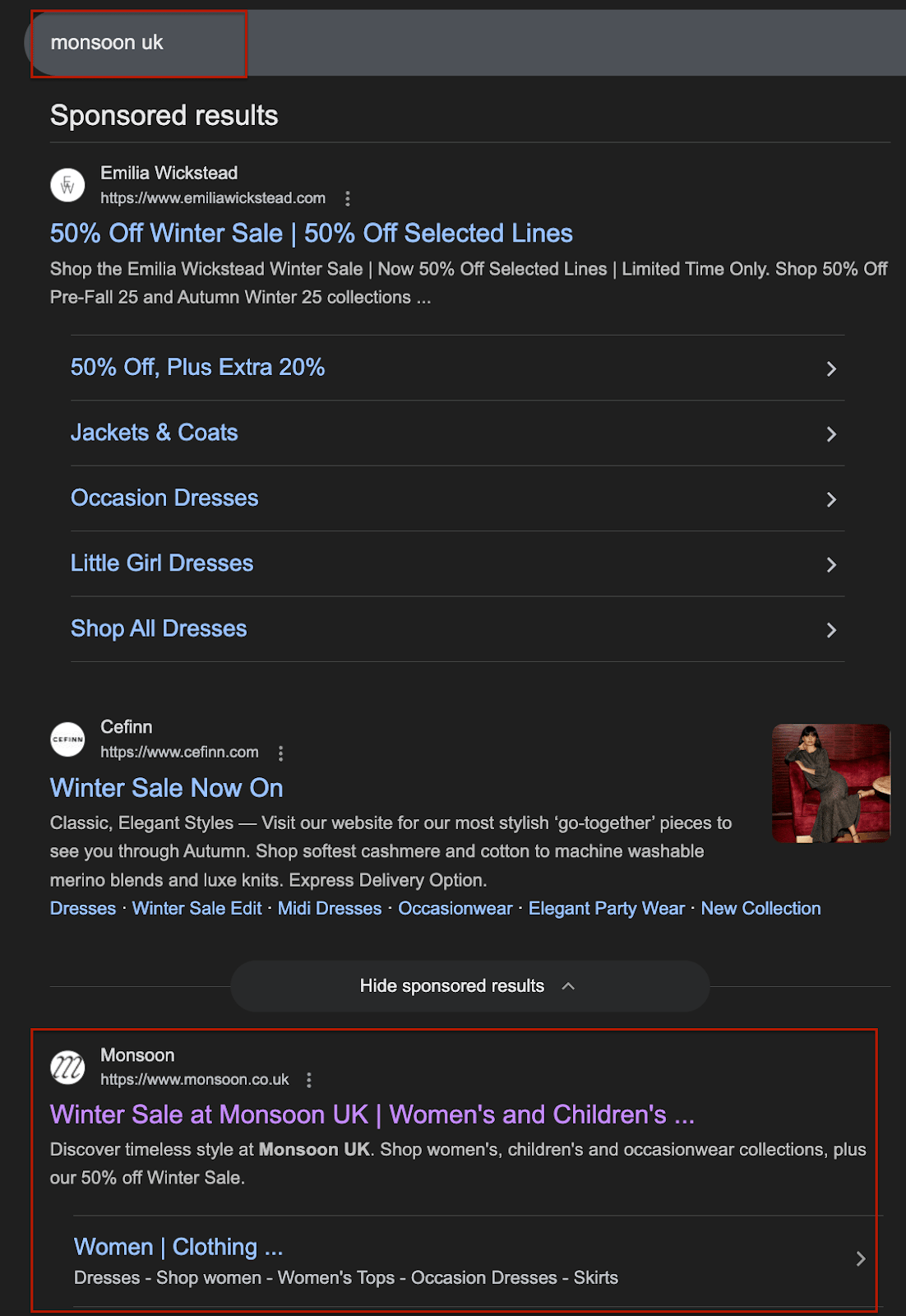
If you are not checking Auction Insights, you are basically running blindfolded and calling it optimization.
Cold keywords: Check who is beating you on the searches you want
Cold, non-brand queries are where growth lives. They are also where you get outclassed if you do not pay attention.
Pull Auction Insights on your core non-brand campaigns and look for:
Who appears above you most often (outranking share)
Who overlaps with you a lot (overlap rate)
Who is taking top positions (top of page rate, absolute top rate)
Who is eating your lunch lately (changes week over week)
Now the part most people miss: the goal is not “bid higher.” The goal is to learn why they can afford to show up where you cannot.
Auction Insights tells you who to study. Your ads, feed, and landing page tell you how to beat them.
Branded keywords: This gets ignored constantly, and it costs real money
Brands love saying, “We own our brand.”
Then you check Auction Insights on brand and surprise: someone is bidding on it.
This happens all the time, and it’s underestimated because brand ROAS still looks good. You think you are fine. Meanwhile:
Your CPCs creep up
Your impression share drops
Your top-of-page presence gets contested
Your cheapest conversions become more expensive than they should be
5. You don't run channels. You run one goddamn system.
Most teams treat Google like a bunch of silos—Search over here, PMax lurking in the corner, Demand Gen off doing whatever. Every week, you get these half-baked "learnings" that go nowhere because nothing carries over. Waste of time.
We do the opposite. We treat the whole account like one learning system. We collect insights at the asset level first. We apply this rule across everything: images, headlines, short copy, long copy, video hooks, and landing page paths. No exceptions. And we do it at the funnel level too. If a promise pulls cold traffic on one network, we test that promise across the rest. If a page structure reduces drop-off, it becomes the default everywhere. This is how we turn scattered wins into a repeatable system, and it’s one of the simplest ways to scale faster without relying on luck.
We also cross-learn between networks weekly. Anything that starts working in one place is instantly tested in the others. If a native style image is popping on native placements, we test it in Demand Gen. If it holds, we build variations and push it wider. And yes, some of the “weird” stuff wins. We’ve seen native-looking images outperform the classic “Google style” statics by a lot, even when it feels wrong or ugly.
Want to brainstorm with us on new ways to scale your business with YouTube Ads (and other performance video platforms)?
Join us for a free YouTube ad brainstorming session here:
 | Vesna Vukanovic Dumanovic, Account Manager Armed with a PhD in Knowledge Management, as well as insatiable curiosity and a can-do attitude, Vesna is an organizational powerhouse on our team. As a veteran in project management, there's no question or task you can throw at her that she wouldn't be able to tackle. That's why she's the go-to resource for education, development, and support not just for our team but for Inceptly's clients. |
🎯 Inceptly’s top picks:
Essential reading you can't afford to skip
This AI indoor walking app ad cleared $1M+ in YouTube ad spend.
The wild part: it’s simple, direct, and built around a few smart persuasion moves most advertisers ignore.
We broke down the hook, the structure, and why it keeps scaling.
These were our most-read posts of H2 2025 — and it wasn’t by accident.
Each one hit a real tension founders and media buyers are dealing with right now: creative fatigue, misleading metrics, and ads that quietly scale while others stall.
We broke down why these posts landed and what patterns kept showing up.
If you want to see what actually resonates with serious advertisers, this is a good place to start:
Get in touch with us by responding to this email or tagging us on LinkedIn or Instagram, and sharing your thoughts. Your feedback helps us keep our newsletter relevant and interesting.
- This newsletter is brought to you by -

Are you spending over $1K/day on ads and looking to scale your business with YouTube ads?