- Inceptly
- Posts
- 👓 The anatomy of a $3M ad: How a blue glasses ad masters controversy
👓 The anatomy of a $3M ad: How a blue glasses ad masters controversy
A deep dive into the psychological tactics behind this high-spender 👀
"Should these glasses be illegal in the US?" That's the opening line of a YouTube ad that's generated nearly $3 million in ad spend: |  Author: |

Within the first four seconds, you're hooked. By the end of the two-minute spot, you understand exactly why this advertiser is scaling so aggressively.
Intrigued? If so, let’s jump right into the analysis of this high-spender together!
Want to brainstorm with us on new ways to scale your business with YouTube Ads (and other performance video platforms)?
Join us for a free YouTube ad brainstorming session here:
First and foremost, let’s watch the ad together:
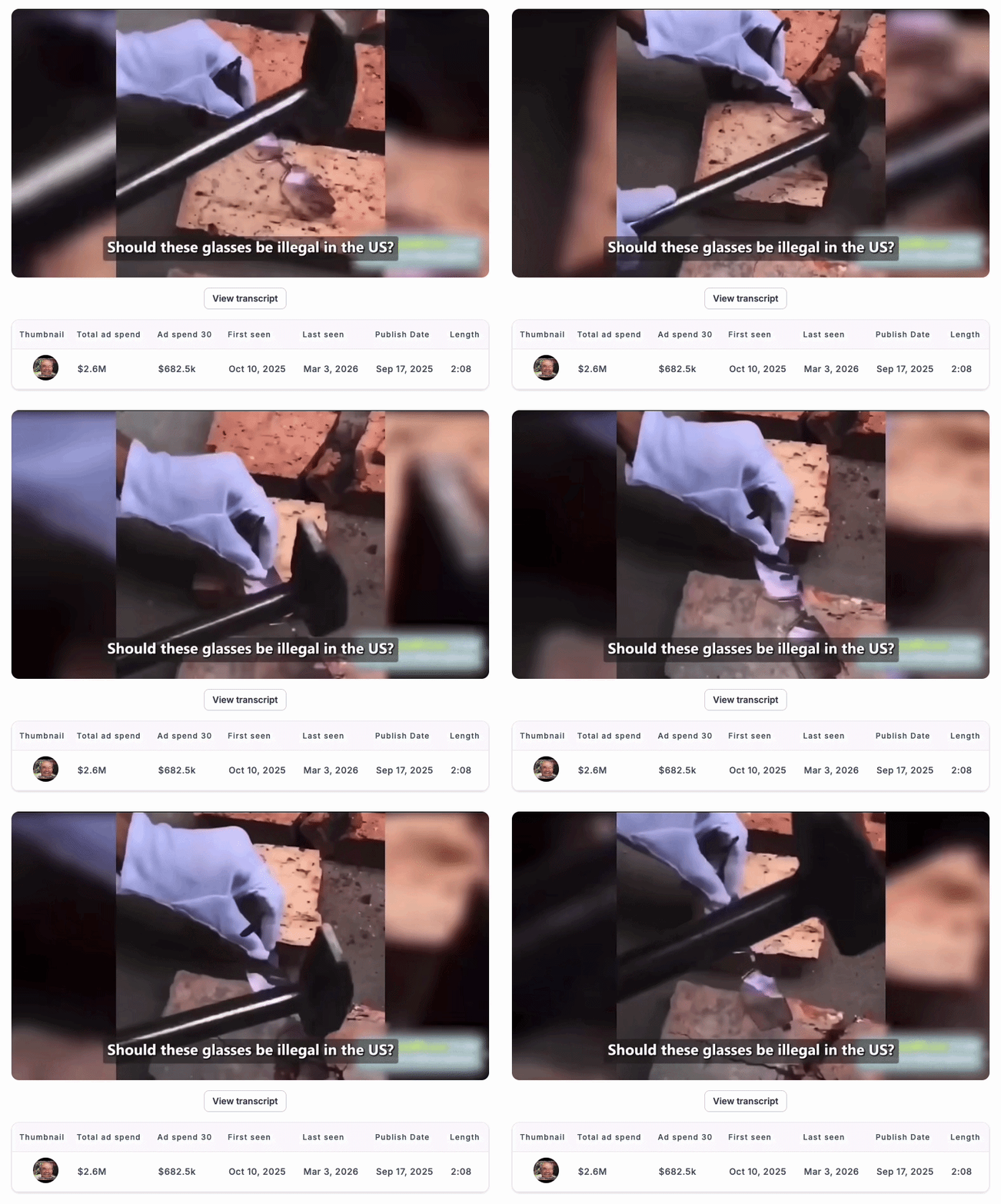
This isn't just another YouTube ad. It's a masterclass in psychological persuasion, controversy-based marketing, and narrative structure.
And whether you're selling eyewear, supplements, or software, there's a lot to learn from how it works!
Let me break down exactly why this glasses ad is spending millions and what makes it so effective.
The controversy hook: Why "Should this be illegal?" outperforms everything else
Most ads open with a benefit claim, something like: "See clearly again!" or "Revolutionary new glasses!"
Clarity Blue doesn't do that.
Instead, it opens with a question that immediately creates cognitive dissonance: Why would glasses be illegal?

This is a pattern interrupt on steroids. You're not thinking about whether you need glasses - you're thinking about why these specific glasses might be banned.
The controversy hook forces you to keep watching just to understand the premise.
But there's a second layer here: "Nobody believed me at first, but now everybody wants a pair."

This is social proof compressed into a single sentence. It tells you:
Other people were skeptical (you're not alone in doubting)
Those people were proven wrong (your skepticism might also be wrong)
Everyone now wants the product (you're late to the party — better catch up)
Within four seconds, the ad has:
Created curiosity through controversy
Validated your skepticism
Positioned the product as socially validated
Created FOMO
That's four psychological triggers before you even know what the product is.
Why this works for cold traffic: Controversy beats benefits because it creates a question the viewer must answer. Benefit claims get ignored; mysteries demand resolution.
Lesson for marketers: If your hook creates an unanswered question directly tied to your product's core mechanism, viewers will keep watching to get the answer. The key is making the controversy feel relevant, not clickbait.
The personal conversion story: The skeptic-to-convert arc
After the hook, the ad immediately shifts into a personal testimonial:
"My friends roasted me for buying Miracle Glasses online. They said I got scammed, but then I showed them what they could do. Now they're all begging me to send them the link."
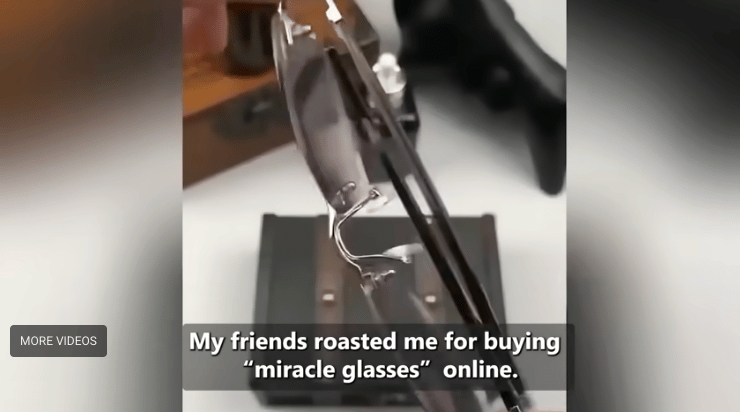
This is one of the most effective trust-building structures in direct response: the skeptic-to-convert narrative.
Why does this work so well?
Because it mirrors the exact mental journey the viewer is going through:
Skepticism: "This sounds too good to be true"
Proof moment: "Wait, maybe it actually works?"
Social validation: "Other people want this too"
By framing the ad as a personal story instead of a brand pitch, Clarity Blue bypasses our natural defenses against advertising. We're not being sold to — we're just overhearing someone's experience.
The "friends roasted me" setup is particularly clever because it acknowledges the natural objection (online vision products seem sketchy) before you even think it. This is called preemptive objection handling, and it's one of the most powerful techniques in copywriting.
When someone voices your objection before you do, and then shows why that objection was overcome, it creates a psychological opening. You think: "If it worked for them despite their skepticism, maybe it'll work for me too."
Why this converts: Third-person testimonials feel more authentic than brand claims. When someone admits they were skeptical first, it gives permission for your skepticism while simultaneously showing a path past it.
Lesson for marketers: Personal conversion stories (skeptic → believer → evangelist) are more persuasive than brand claims. If you can show someone who was more skeptical than your viewer and still converted, you've created a bridge across the credibility gap.
The "magic" mechanism: Auto-adjusting as the core claim
Here's where the ad introduces its central product claim:
"These things actually adjust automatically to your eyes, whether you're reading a book or looking across a room. They correct both farsightedness and nearsightedness without needing a prescription."

This is the hook's payoff — the answer to "why would these be illegal?"
The mechanism is positioned as almost magical: glasses that automatically adjust based on what you're looking at. No prescription needed. No doctor visits. No lens swaps.
Notice the language: "automatically adjust" (emphasis on effortless), "whether you're reading or looking across a room" (demonstrates range), "without needing a prescription" (removes medical barrier).
The specific diopter range mentioned later (100-700) adds technical credibility. Most viewers don't know what diopters are, but the precision implies legitimacy.
Why this mechanism works psychologically:
It solves multiple problems at once (near + far vision, blue light protection, UV)
It removes friction (no doctor, no prescription, no multiple pairs)
It sounds advanced, but not impossible (we live in an age of smart devices)
It has a clear "unfair advantage" (technology others don't have)
The product is positioned not as better glasses, but as a different category entirely — vision technology.
Lesson for marketers: Your mechanism should sound advanced enough to feel special, but believable enough not trigger immediate skepticism. The sweet spot is "this should exist" rather than "this can't possibly exist."
The seven reasons list: Cognitive saturation strategy
After establishing the core claim, the ad shifts into feature-dump mode:
"Let me give you seven reasons why Clarity Blue glasses are blowing up right now."

Then it rapid-fires through:
Auto-adjusting vision (100-700 diopters)
Blue light and UV protection
Lightweight (1.5 grams)
Impact-resistant and durable
Universal use cases (reading, driving, computer work)
Perfect for any age
One-time purchase (no subscriptions)
This is a classic infomercial structure, and it works for a specific psychological reason: cognitive saturation.
When you're hit with seven distinct reasons in quick succession, your brain doesn't have time to critically evaluate each one. Instead, you walk away with a general impression: "These glasses solve everything."
Notice how the list stacks benefits across different dimensions:
Technical (auto-adjusting, blue light)
Physical (lightweight, durable)
Practical (multiple uses, no age limit)
Financial (one-time purchase)
This is called benefit diversification. Instead of just hammering vision correction, the ad appeals to multiple buyer personas:
The tech enthusiast (auto-adjusting mechanism)
The screen worker (blue light protection)
The senior with multiple prescriptions (replaces multiple glasses)
The budget-conscious buyer (no ongoing costs)
Each viewer finds at least one reason that resonates with them personally.
Why rapid-fire lists work: Speed prevents deep processing. The goal isn't for viewers to remember all seven reasons — it's to create an overwhelming impression of value.
Lesson for marketers: When selling a complex product, feature lists work IF you move fast enough. Don't give viewers time to question each claim individually. Create a "more is better" impression through volume.
The conspiracy element: Banned for being "too powerful."
And now we arrive at one of the most controversial parts of the ad:
"And here's the kicker. They're already banned from Amazon, Walmart, and Home Depot for being too powerful."

This is conspiracy marketing, and it serves multiple psychological functions:
Explains absence from mainstream channels: "Why haven't I seen this in stores?" → Because retailers won't carry it
Creates underdog positioning: You're supporting innovation against established interests
Implies effectiveness: If major retailers feel threatened, the product must be disruptive
Generates urgency: If it's being suppressed, it could disappear at any time
Whether this claim is literal, metaphorical, or something else entirely, the marketing function is clear: it converts a potential red flag (no major retail presence) into social proof.
This taps into existing skepticism about large corporations and creates an "us vs. them" dynamic where buying the product feels like an act of rebellion or insider knowledge.
Why this works: Conspiracy narratives explain away objections before they're raised. "Why isn't this everywhere?" becomes evidence FOR the product rather than against it.
Lesson for marketers: When your product has characteristics that might raise questions (only available online, not in major stores, relatively unknown brand), you can reframe those as features rather than bugs. "We're being kept out" is more compelling than "we haven't gotten distribution yet."
The close: Multi-layered risk reversal and social callback
The ad ends with a classic direct response stack:
"Right now, Clarity Blue glasses are offering 50% off and a 30-day money-back guarantee. But this deal won't last long. Once they're sold out, they're gone."

This is DR 101:
Discount: 50% off creates price anchoring (even without stating original price)
Risk reversal: 30-day guarantee removes purchase anxiety
Scarcity: Limited inventory creates urgency to act now
But the final line is what ties the whole thing together:
"Before your friends start begging for the link too."
This circles back to the opening social proof story. It reactivates the image of friends going from mockery to desperate desire. It plants the idea that you'll be the one others come to for recommendations.
It transforms the purchase from "buying glasses" to "joining an exclusive group of people who know about this innovation."
Why this close works: It echoes the opening hook, creating narrative satisfaction. The full-circle structure makes conversion feel like the natural conclusion to the story.
Lesson for marketers: Your close should mirror your hook. If you opened with social proof, end with social proof. If you opened with urgency, end with urgency. Circular structure creates narrative completion.
Why this ad scales to $3M in spend
Most ads can't sustain that level of spend. So what makes this one different?
It works on cold traffic: The controversy hook stops scrollers immediately. You don't need to know anything about the brand to be intrigued by "Should these be illegal?"
It handles objections proactively: Every major objection (sounds like a scam, too good to be true, why isn't this mainstream) is addressed before viewers consciously raise it.
It appeals to multiple demographics: The benefit diversification means it converts across age ranges, use cases, and buyer motivations.
It has a clear mechanism story: "Auto-adjusting lenses" is simple enough to understand but impressive enough to share. Mechanism clarity = higher conversion.
It creates urgency without desperation: The conspiracy angle and inventory scarcity feel legitimate rather than manufactured.
The narrative structure is tight: Hook → Story → Mechanism → Proof → Urgency → Close. Nothing wasted. Every second serves the conversion goal.
When an ad can convert cold traffic efficiently across multiple demographics while maintaining engagement for 2+ minutes, that's when you get $3M+ in sustainable spend.
The DR formula behind the success
If we distill this ad down to its core structure, here's the formula:
1. CONTROVERSY HOOK → Creates immediate curiosity
2. PERSONAL CONVERSION STORY → Validates skepticism then overcomes it
3. MECHANISM REVEAL → Shows WHY product works differently
4. RAPID BENEFIT STACKING → Overwhelms with comprehensive value
5. CONSPIRACY/UNDERDOG ELEMENT → Explains away red flags
6. RISK REVERSAL + SCARCITY → Removes final purchase barriers
7. SOCIAL PROOF CALLBACK → Closes the narrative loop
This isn't just thrown together. This is a carefully engineered persuasion sequence where each element builds on the previous one.
And here's the key: each element serves multiple functions.
The controversy hook doesn't just grab attention — it also sets up the mechanism reveal.
The personal story doesn't just build trust — it also preemptively handles objections.
The conspiracy element doesn't just create urgency — it also explains the product's market positioning.
This kind of layered, multi-functional copy is what allows an ad to work hard enough to justify massive media spend.
Seemingly just an ad for a simple product, but turns out we can all learn a thing or two from this one! 🤓
Want to brainstorm with us on new ways to scale your business with YouTube Ads (and other performance video platforms)?
Join us for a free YouTube ad brainstorming session here:
| Kristina Jovanovic, Social Media Manager & Content Writer Fascinated by human behavior, Kristina graduated with a degree in Psychology and joined our agency to put her knowledge to good use as a Media Buyer. She later transitioned into her current role, where she draws on her knowledge of the human psyche and marketing strategy, as well as hands-on experience in creative development and media buying at Inceptly, to share useful insights with our readers. |
🎯 Inceptly’s top picks:
Essential reading you can't afford to skip

AI-generated ads are everywhere right now… but most of them feel cheap.
Not these.
Tai Chi Walking is running conversational YouTube ads powered by AI visuals that are both cost-effective and surprisingly persuasive.
One ad starts with a simple line:
“Daughter’s wedding is in a month…”
From there, it turns into a perfect direct-response structure: emotional hook → objection handling → bold efficiency claim → clear CTA.
We break down exactly why this works.
This “fake” expert helped scale an ad to $3.1M in spend.
The presenter?
An AI-generated avatar in a suit speaking at a conference.
But the real story isn’t the avatar.
It’s the direct-response structure behind the ad:
problem agitation → pattern interrupt → unexpected solution → authority → scarcity.
In the breakdown, we analyze why this ad works and what marketers can steal from it.
Get in touch with us by responding to this email or tagging us on LinkedIn or Instagram and sharing your thoughts. Your feedback helps us keep our newsletter relevant and interesting.
