- Inceptly
- Posts
- This ad invented a fake anatomy term. Then scaled to $960K in 30 days🔥
This ad invented a fake anatomy term. Then scaled to $960K in 30 days🔥
"O-Pumps" don't exist. The conversion rate does. Full breakdown inside.
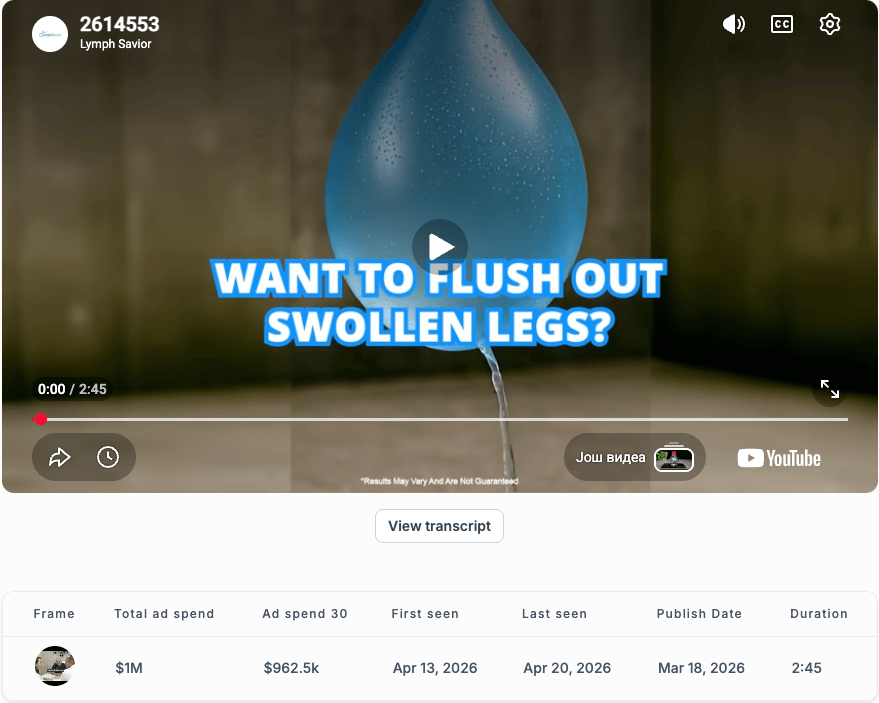
Someone is spending $32,000 a day on a single video ad about swollen legs. A 2-minute and 45-second direct response video. An elderly doctor in a hospital hallway. A 3D animation of knee lymph nodes. And a proprietary term called "O-Pumps" that doesn't exist in any medical textbook — yet it has generated nearly $1 million in ad spend, with $960k of that landing in the last 30 days alone. |  Author: |
At that scale, the math tells you everything you need to know. This creative isn't being tested. It's being scaled — aggressively, deliberately, and repeatedly — because the returns keep justifying the spend.
So the only question worth asking is: why does it work?
That's what this analysis is for. Not to admire it. To dissect it — section by section, mechanism by mechanism — so you can extract the principles and apply them to your own campaigns.
Want to brainstorm with us on new ways to scale your business with YouTube Ads (and other performance video platforms)?
Join us for a free YouTube ad brainstorming session here:
The architecture of attention
This ad deploys three simultaneous hooks in its first two seconds, and each one is doing a different job.
The on-screen text hook — "WANT TO FLUSH OUT SWOLLEN LEGS? STOP DOING THIS FIRST" — is the sharpest of the three. It speaks directly to someone mid-action, implying they are currently doing something wrong. That single word, "STOP," creates an involuntary pause. It targets a Problem-Aware audience who has already tried something — elevation, compression, water pills — and frames their existing behavior as the obstacle, not the solution. That reframe happens before a single word is spoken.
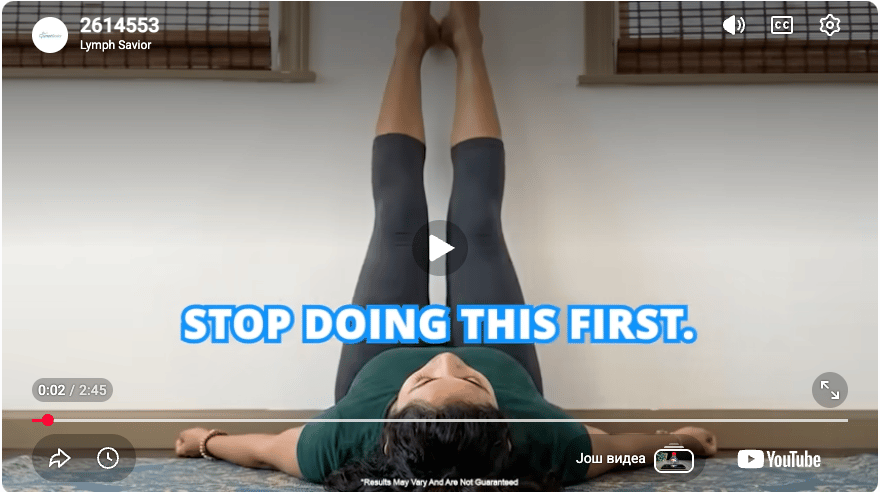
The visual hook — a woman with legs propped against a wall in a yoga pose — is the behavioral mirror. It shows the exact thing the text just told you to stop. The viewer recognizes themselves or someone they know. Recognition creates engagement.
The spoken hook — the elderly doctor saying "I'm going to show you something about leg swelling that might surprise you" — is the credibility anchor. It signals education, not selling.
Together, these three elements target a Problem-Aware to Solution-Aware audience — people who know they have swollen legs, have tried things, and are still looking. The sophistication level is 3 to 4. Simple claims ("reduce swelling naturally") are dead in this market. The ad bypasses them entirely by introducing a mechanism no competitor has named.
The lead into the main content is seamless. The doctor's question — "Most folks have heard about lymph nodes, right?" — is a soft agreement bridge. It assumes shared knowledge, makes the viewer feel competent, and then immediately introduces something they haven't heard. That gap between what they know and what they're about to learn is what pulls them forward.
The mechanism is the product
The term "O-Pumps" is the single most important creative decision in this entire ad. It is not a flourish. It is a strategic weapon.
By giving the popliteal lymph nodes a proprietary nickname, the advertiser takes ownership of the problem narrative. Your doctor calls them lymph nodes. This ad calls them O-Pumps. That naming difference quietly repositions every other solution as incomplete — because no one else is talking about O-Pumps. The Big Idea is simple: your leg swelling isn't a fluid problem. It's a pump problem. And nobody has been fixing the pumps.
The narrative arc follows a clean three-act structure:
Setup: your O-Pumps are clogging with sticky proteins and toxins.
Conflict: everything prescribed — compression, water pills, elevation — ignores the pumps entirely and makes things worse long-term.
Resolution: there is one method, developed by one specialist, that actually unclogs the pumps at the source.
The product is not introduced until after the 90-second mark. That delay is load-bearing. By the time Dr. John Jairo's method is mentioned, the viewer has already accepted the mechanism, rejected the alternatives, and felt genuine fear about what happens if nothing changes. The solution lands in a prepared mind.
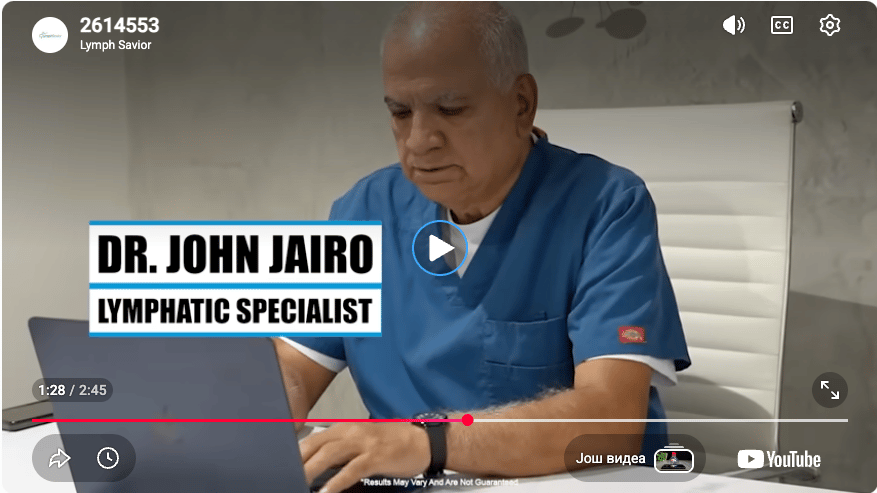
The proof is not a clinical study. It's a statistic ("73% of all leg fluid flows through these pumps"), a visual demonstration via 3D animation, and a social proof number (54,000 people helped). Precise, visual, and human — the three elements that bypass skepticism without requiring peer-reviewed evidence.
Who this ad is talking to
Drew Eric Whitman, author of “Ca$hvertising”, argues that every human being on the planet is hardwired with eight biological desires so deep and so primal that no amount of cultural conditioning can override them. He calls them the Life Force 8:
Survival, enjoyment of life, life extension
Enjoyment of food and beverages
Freedom from fear, pain, and danger
Sexual companionship
Comfortable living conditions
To be superior, winning, keeping up with the Joneses
Care and protection of loved ones
Social approval
Good advertising doesn't choose one and hope for the best. Great advertising stacks them — and this ad stacks them with precision.
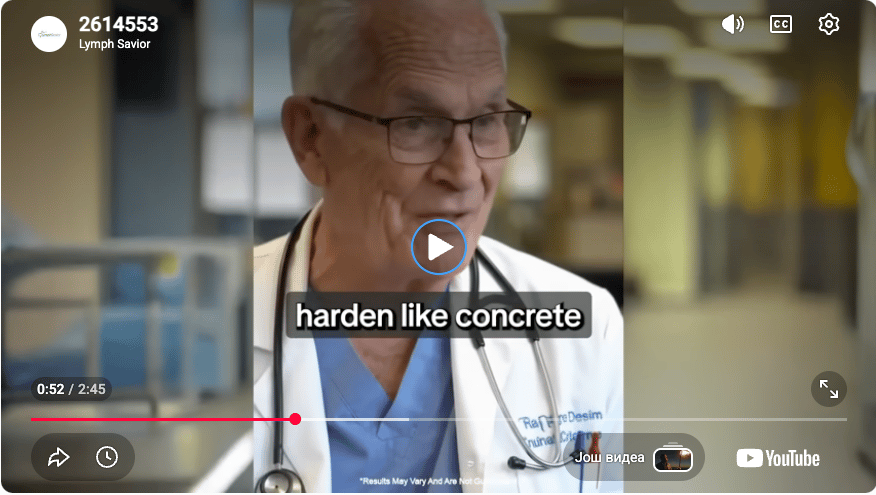
The primary drive targeted is number one: survival and life extension. More specifically, the terror of physical deterioration and the loss of independence. This ad doesn't just tell you things might get worse. It shows you. The walker. The operating table. The phrase "harden like concrete in your legs." These images aren't decorative — they are deliberate psychological anchors, each one attaching the viewer's deepest biological fear to the consequence of inaction.
The secondary drives are number three (freedom from fear and pain) and number five (comfortable living conditions). Notice how the ad closes. A woman in bed, coffee in hand, morning light, completely at ease. That image isn't selling a product. It's selling the return of something ordinary — a quiet morning without pain — that has become the avatar's most desperately wanted luxury.
The emotional valence arc moves precisely: curiosity (0:05) → mild concern (0:30) → visceral fear (0:53) → manufactured relief (1:42) → fear re-spike (2:15) → aspiration and resolution (2:35).
The intensity peaks at around 8 out of 10 during the walker and operating table sequence — and that number matters. This avatar is already living with daily pain. She has already tried the standard solutions and been disappointed. She is emotionally primed and biologically receptive. A softer approach, a 4 or 5 out of 10, wouldn't cut through the scroll. A harder approach, pushing toward 10, would activate the skepticism reflex this audience has developed from years of being sold miracle cures. The 8 out of 10 hits the precise threshold — it breaks inertia without triggering the "this is too good to be true" shutdown.
The demographic this arc is built for is specific: 60 to 80 years old, most likely female, dealing with chronic and worsening leg swelling, has already purchased and been disappointed by compression socks, and carries a low-grade but persistent distrust of doctors who acknowledge her symptoms without ever truly solving them.
The persuasion engine
The belief transfer follows four steps: name the mechanism, visualize it, show that all existing solutions ignore it, present the only solution that addresses it directly. By step four, the viewer isn't being sold to. They're being rescued.
Competitive disqualification is handled with particular elegance. Compression socks and water pills are not attacked. They are reframed as solutions to the wrong problem — they address fluid, not pumps. That distinction makes the argument nearly impossible to resist, because it doesn't require the viewer to believe their doctor was wrong, only incomplete.
Every high-converting direct response offer can be evaluated through four positioning lenses that answer the four questions every skeptical buyer is silently asking before they click anything. Marketers call this the NESB framework:
New: How is it presented as novel or different?
Easy: How is it framed as simple or low-friction?
Safe: How is risk reduced?
Big: How are the results framed as significant?
This ad answers all four — but it doesn't lean on them equally.
The heaviest weight sits on New. The O-Pumps mechanism, the popliteal node clogging theory, the three-step dissolve-repair-restore sequence — none of this exists in the vocabulary of any competing solution. The viewer has never heard this framing before, which means they have no existing resistance to it. A new mechanism is a clean slate.
Safe carries the second heaviest load. The method is explicitly at-home. No surgery. No prescription. No commitment gated behind an email address. Each of those details is a direct response to a specific fear this demographic carries — fear of invasive procedures, fear of pharmaceutical side effects, and the very modern fear of handing over personal information to a website they've never heard of.
Easy is woven into the CTA language rather than stated outright. "Super quick." "Every single step." "Short video." The ad never says "this is easy" — it demonstrates ease through the framing of what comes next, which is far more believable than a direct claim.
Big is handled through the before-and-after contrast. The before is walkers, operating tables, and legs that have hardened like concrete. The after is slim, pain-free legs and quiet mornings with coffee. The gap between those two images doesn't need a number attached to it. The contrast does the work.
The formula, the voice, and what you can steal
The conversational language patterns are what keep this from feeling like an ad. "Now watch this." "Trust me." "Look, I've been studying this for 15 years." These are not polished marketing phrases. They are the verbal tics of a knowledgeable person talking directly to you — which is exactly what makes them work.
The native integration is precise. Hospital hallway. White coat. Direct-to-camera. Handheld-feeling footage. It mirrors health education content that performs organically, making the ad feel algorithmically served rather than media-bought.
The positioning is a deliberate Friend/Authority hybrid. The narrator doctor plays the convert — someone who learned this from an expert — making him relatable. Dr. John Jairo carries the authority weight, making him credible. The split makes both figures more effective than either would be alone.
The ad formula, timestamped: Pattern interrupt hook (0:00–0:02) → Curiosity bridge (0:02–0:08) → Mechanism introduction (0:08–0:22) → Problem agitation, escalating to fear (0:22–1:00) → Competitive disqualification (1:00–1:20) → Authority and social proof (1:20–1:36) → Solution mechanism, three-step (1:36–1:59) → Outcome painting (1:59–2:07) → Primary CTA with friction removal (2:07–2:14) → Fear re-spike (2:14–2:28) → Secondary CTA with aspiration close (2:28–2:45).
That sequence is the replicable blueprint. The product, the condition, and the specialist can all change. The architecture holds.
What this ad ultimately proves is something that makes a lot of sophisticated marketers uncomfortable: at sufficient depth of pain, a precisely engineered 2-minute and 45-second video with no celebrity, no brand recognition, and no production budget worth mentioning can outperform almost anything in its market — if it names the right mechanism, targets the right fear, and earns trust before it asks for a click. The $1 million in ad spend isn't the story. The reason it keeps getting spent is.
P.S. Want to engineer ads that can actually hold spend at scale? If you’re testing new hooks, stacking proof, or tightening your first 2 seconds, drop us a line. We’ll help you turn the patterns into a repeatable system you can run across offers and markets.
Let’s break down your funnel and see where scale is hiding!
Most brands wait too long to find out why YouTube isn’t working. We’ll show you what to test — and what to kill:
 | Jelena Denda Borjan, Staff Writer Drawing from her background in investigative journalism, Jelena has an exceptional ability to delve into any subject, no matter how complex, dig deep, and present information in a clear and accessible manner that empowers readers to grasp even the most intricate concepts with ease. |
🎯 Inceptly’s top picks:
Essential reading you can't afford to skip

UGC has a new problem in 2026: people can spot the format before they hear the pitch. The giveaway usually is not the camera quality; it is the performance, the pacing, and the feeling that someone is acting out a template instead of saying something real.
This piece breaks down where that signal actually comes from, and why the real test of authenticity now starts long before production.
Most ad breakdowns tell you why something worked.
This one shows you how to turn that into a system. It breaks a winning ad into the exact parts doing the heavy lifting, so you can stop guessing, start spotting leverage points, and build better variations much faster.
Get in touch with us by responding to this email or tagging us on LinkedIn or Instagram and sharing your thoughts. Your feedback helps us keep our newsletter relevant and interesting.
